
The painter who set modern art in motion approached, in his planes of colour and his refusal of a single fixed viewpoint, the very recognition the contemplative traditions name: the dissolving of the line between seer and seen, figure and ground, self and world.
Paul Cézanne, born in Aix-en-Provence in 1839, is remembered as the painter who set modern art in motion — the figure Picasso and Matisse alike would call “the father of us all.” Yet beneath that art-historical achievement runs a quieter inquiry. In his interlocking planes of colour, his refusal of a single fixed viewpoint, and his patient return again and again to the same mountain, Cézanne approached something the contemplative traditions name directly: the dissolving of the line between seer and seen, figure and ground, self and world.
This article reads Cézanne’s life and work through the lens of nonduality — the perennial recognition that apparent opposites are aspects of a single, undivided reality. It follows his formation in Provence and Paris, the hostile art world he helped to break open, the nondual logic of his technique, the key works in which that logic becomes visible, his role as the hinge between Impressionism and Cubism, and the way modern neuroscience now describes the very act of perception his paintings ask of us.
Paul Cézanne’s Artistic Biography and Early Influences
Paul Cézanne was born on 19 January 1839 in the town of Aix-en-Provence. He came from a wealthy family; his father, Louis-Auguste Cézanne, shifted from making hats to working in banking and co-founded the Banque Cézanne et Cabassol. This financial success gave Paul the freedom to pursue his art. His mother, Anne-Elisabeth-Honorine Aubert, had a lively yet sensitive nature that subtly shaped his way of seeing.
Childhood and Education
Cézanne spent his early years in Aix, attending primary school with his sisters before moving on to the Saint Joseph school at the age of ten. This environment fostered important friendships, particularly with Émile Zola, whose energetic writing and intellectual companionship shaped Cézanne’s youthful thoughts on art and life. Alongside Zola, Philippe Solari, who would later become a sculptor, and Henri Gasquet — father of Joachim Gasquet, who would go on to write a significant book about Cézanne — formed a close-knit group affectionately known as “Les Trois Inséparables.”
Artistic Development
Cézanne’s education also included studying art at the Free Municipal School of Drawing in Aix under Joseph Gibert. Although he initially pursued law at the University of Aix-en-Provence to meet his father’s expectations, he found himself increasingly drawn towards visual expression. This struggle between fulfilling family obligations and following his creative passion defined his early path.
In April 1861, Cézanne moved to Paris, the centre of avant-garde creativity, hoping to receive formal artistic training. His rejection by the École des Beaux-Arts was a turning point; instead, he went to the more accessible Académie Suisse, where he focused on drawing from life and met artists such as Camille Pissarro and Achille Emperaire. Pissarro’s guidance sparked Cézanne’s interest in Realism and Romanticism, combining careful observation with emotional depth.
Influences from Art History
At the Louvre, Cézanne spent hours copying masterpieces by Michelangelo, Rubens and Titian — an exercise aimed at absorbing classical technique while developing his own style. His friendship with Pissarro evolved beyond teacher and student into collaboration during outdoor painting trips around Louveciennes and Pontoise. These experiences nurtured an experimental approach to form and colour that challenged existing academic norms.
The impact of these early influences — financial stability allowing freedom, companionship with Zola and Solari enriching his intellectual life, institutional obstacles softened by persistent study under Pissarro — intertwined within Cézanne’s evolving vision. They laid the foundation for a body of work that would bridge tradition and innovation through a profound exploration of reality’s visual essence.
Historical Context: The French Art Scene in Cézanne’s Time
When Paul Cézanne began his career, the art world was passing through a period of upheaval. A struggle was under way between the old academic style of painting and new, experimental ways of expression.
The Conflict Between Tradition and Innovation
The Salon des Refusés of 1863 captured this conflict precisely. It exhibited works that had been rejected by the official Paris Salon jury, marking a turning point in artistic norms and challenging the dominance of academic conventions that prized idealised form and strict perspective.
Critics’ Response to Cézanne’s Work
Cézanne’s early exhibitions were met with confusion and often outright ridicule from critics steeped in classical aesthetics. His departure from naturalistic representation and his refusal to follow established rules provoked incomprehension. Critics dismissed his explorations as amateurish or unfinished rather than recognising their profound innovation.
Ambroise Vollard: The Champion of Cézanne
In the midst of this hostility, the dealer Ambroise Vollard emerged as a crucial supporter. His organisation of Cézanne’s first solo exhibition in Paris in 1895 marked a significant turning point. The show allowed far more people to encounter Cézanne’s groundbreaking style — his fragmented shapes, his varied areas of colour, his focus on structure. Vollard’s backing repositioned Cézanne not as an outsider but as a precursor to new artistic possibilities.
Shifting Artistic Movements
Through the late nineteenth century there was a gradual move away from academic art towards movements that embraced complexity, uncertainty and diversity — qualities close to a nondual aesthetic. Artistic communities increasingly valued individual perception and the breaking down of oppositions such as form versus background, or figure versus ground.
Broader Changes in the Art World
Cézanne’s struggles reflected these larger changes:
- Rejection by official institutions highlighted resistance to his subversion of linear perspective and traditional composition.
- Critical disdain concealed discomfort with his challenge to binary visual logic.
- Support from avant-garde patrons like Vollard enabled the spread of innovative methods that questioned dualistic frameworks.
This context places Cézanne at the intersection of old and new, where his vision expressed an emerging paradigm aligned with philosophical ideas of unity beyond obvious opposition.
Nonduality and Cézanne’s Artistic Style
Cézanne’s artistic language embodies a profound inquiry into visual perception, moving past the mere depiction of objects towards a synthesis that resonates deeply with the philosophy of nonduality. His methodical use of the planes of colour technique is a radical departure from conventional representation, one in which discrete elements coexist without fragmentation or hierarchical separation.
Planes of Colour as Expressions Beyond Dualism
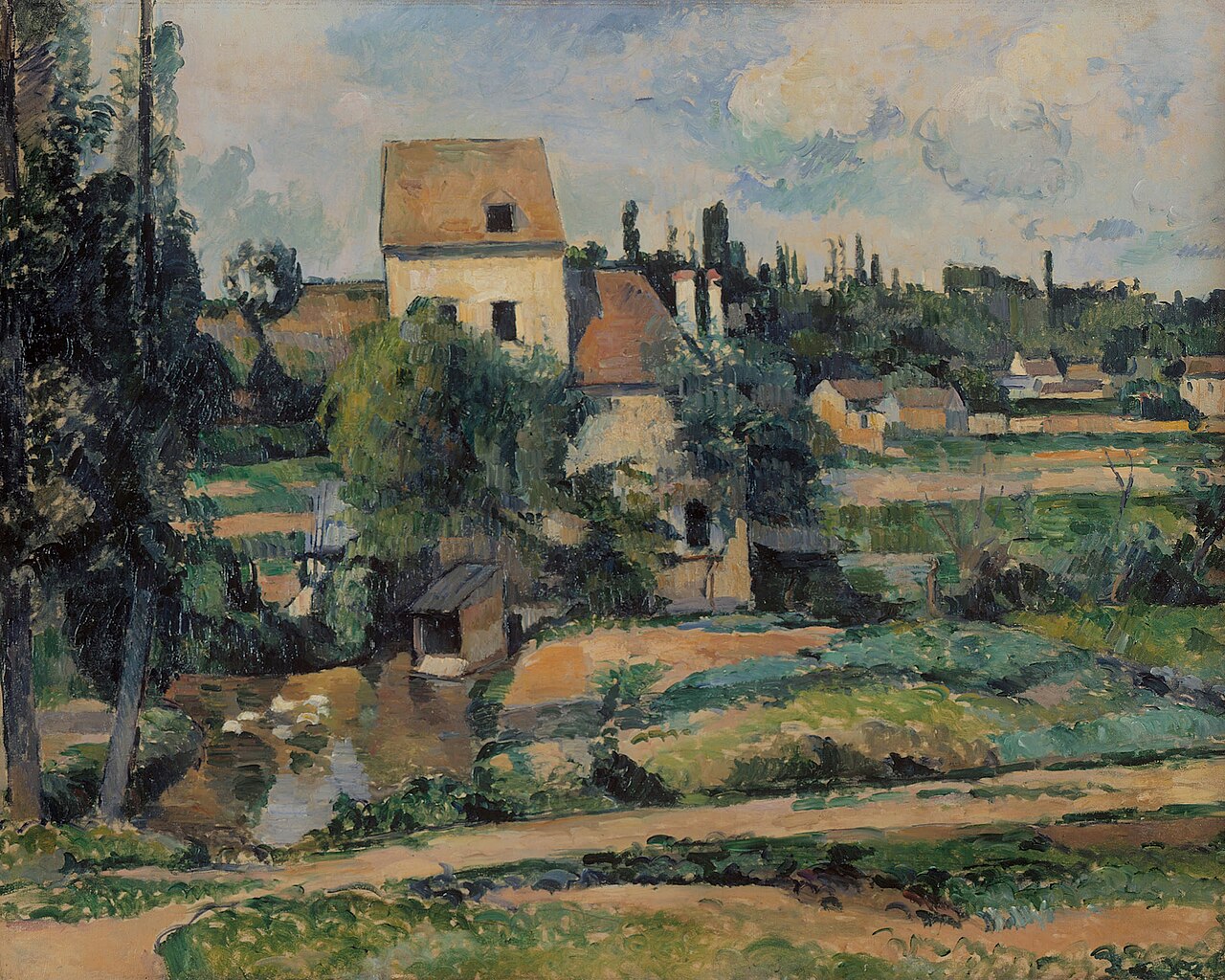
Cézanne’s canvases reveal a composition built through interlocking planes of colour, each modulated with subtle tonal shifts rather than stark contrast. These planes do not merely delineate form; they evoke an interplay between presence and absence, inviting contemplation of the fluid boundary between figure and ground. The repetitive, exploratory nature of his small brushstrokes serves not only as a structural device but as a metaphor for continuous becoming — a visual rhythm that resists fixed definition.
The landscape is not simply what you see, but what you feel beneath it.
Paul Cézanne
This feeling aligns with nondual awareness, where distinctions dissolve into a unified field that manifests multiplicity without division.
Altered Perspective: From Singular Viewpoints to Ambiguity and Unity
Rejecting the Renaissance-derived single-point perspective, Cézanne introduced multiple overlapping viewpoints within a single composition. This dismantles the classical illusion of fixed spatial depth and substitutes a dynamic ambiguity in which objects appear at once distinct and interwoven. The approach mirrors nondual thought, which holds that apparent opposites — proximity and distance, inside and outside — are inseparable aspects of a single reality.
- Overlapping planes collapse conventional spatial logic.
- Ambiguity arises through juxtaposition rather than clarity.
- Unity manifests in multiplicity rather than separation.
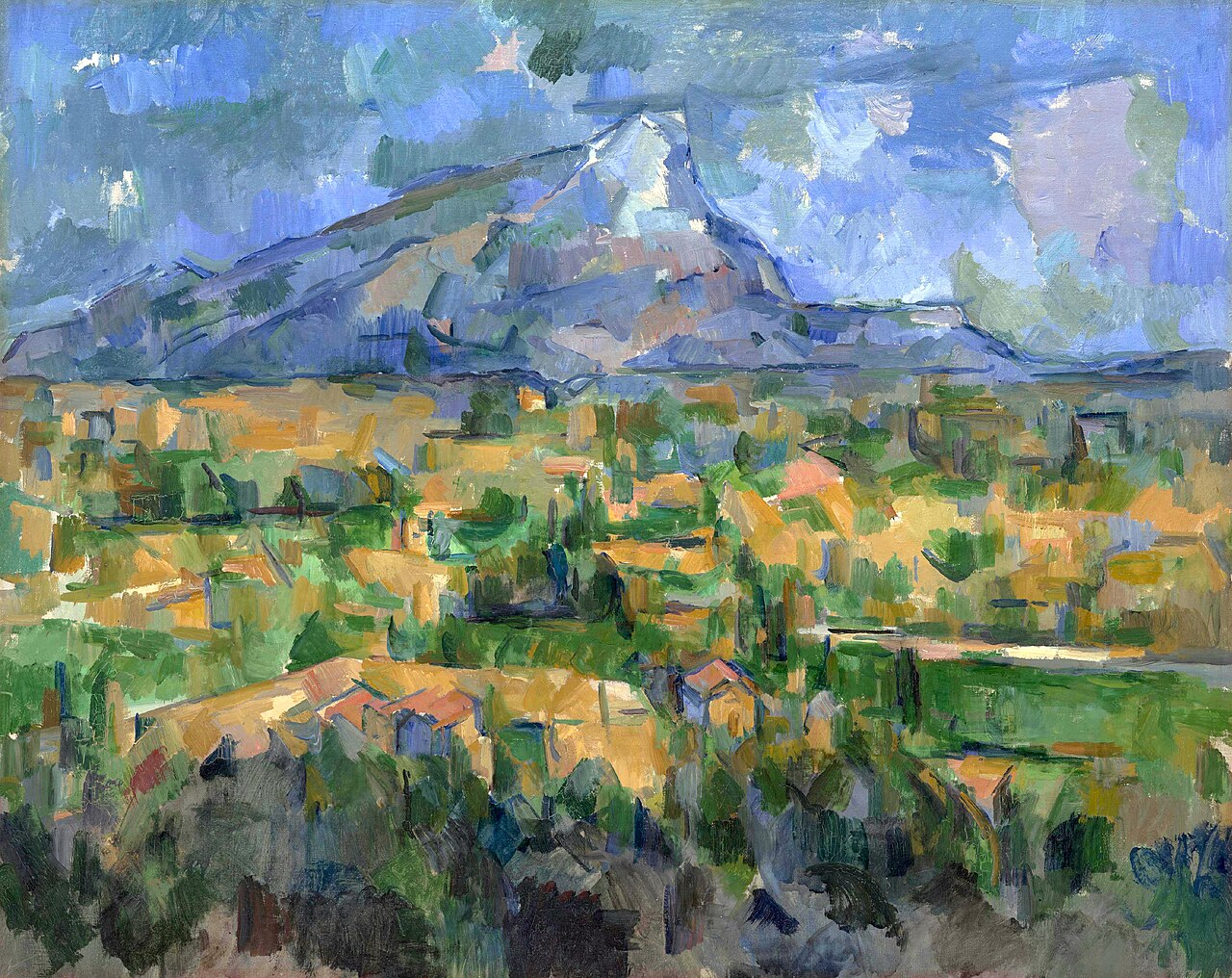
In landscapes like Mont Sainte-Victoire, this multiplicity is palpable: the mountain’s mass shifts subtly under varying planes of colour, revealing hidden patterns that emerge only through prolonged engagement. The effect is not confusion but enriched understanding — a pictorial expression of vagueness coexisting with precision.
Nondual Concepts Embodied in Technique
The dialectic between vagueness and precision in Cézanne’s work reflects key tenets of nonduality. His paintings resist binary categories such as figure and ground, or object and subject, by holding their simultaneous truth:
- Vagueness — evoked by blurred transitions and layered brushwork suggesting impermanence.
- Precision — manifested in geometric simplification and deliberate compositional balance.
This tension invites the viewer to perceive beyond appearances towards an intuitive grasp of underlying wholeness. Cézanne’s landscapes exemplify the principle: natural forms are distilled into elemental shapes yet remain vibrantly alive, hinting at concealed structures beneath surface phenomena. Such strategies demand active participation — the viewer must negotiate perceptual complexity, assembling fragmented cues into coherent wholes, in a process that resonates with a nondual way of knowing that prizes relationship over division.
Key Artworks Reflecting Nondual Themes
Cézanne’s body of work offers profound insight into nondual philosophy through its persistent engagement with incompleteness, ambiguity and the subtle interplay between presence and absence. His paintings do not merely depict reality; they evoke a dynamic process of becoming, where boundaries dissolve and multiplicity converges into unity.
The Mont Sainte-Victoire Series
The Mont Sainte-Victoire series stands as a testament to Cézanne’s exploration of spatial complexity and perceptual ambiguity. These landscapes abandon conventional perspective, presenting instead overlapping planes of colour that simultaneously assert and undermine depth:
- The mountain emerges not as a fixed object but as a shifting form, composed of interlocking facets that resist a single interpretation.
- Overlapping brushstrokes produce a rhythmic oscillation between foreground and background, reflecting the nondual notion that subject and object co-arise without strict separation.
- Hidden patterns invite the viewer to perceive the unity underlying apparent multiplicity, echoing ancient teachings on the interdependence of all phenomena.
Such paintings become a visual meditation on vagueness and precision — clarity arising not from discrete outline but from the harmonious tension among partially revealed forms.
The Bathers Series
In The Bathers, Cézanne abstracts the human figure into elemental shapes that merge fluidly with their setting. The series shows how form and space become inseparable within his vision:
- Figures are rendered with simplified contours and modulated planes of colour that fuse into the surrounding landscape.
- The distinction between body and setting blurs, suggesting an embodied unity with nature reminiscent of nondual teachings on interconnectedness.
- The rhythmic arrangement of forms invites contemplation of cyclical movement and transformation rather than static identity.
This synthesis challenges classical figural representation by foregrounding relational existence over isolated entities.
Rideau, Cruchon et Compotier
Still lifes such as Rideau, Cruchon et Compotier articulate nonduality through geometric simplification and spatial ambiguity. Objects lose their conventional solidity, becoming facets within an integrated pictorial field:
- Cylinders, spheres and folds of drapery are reduced to interlocking shapes whose edges both reveal and conceal boundaries.
- Colour modulation creates depth without recourse to traditional perspective, fostering a sense of simultaneity in which multiple viewpoints coexist.
- The dissolution of clear separations between objects underscores the theme that distinctness is provisional, contingent upon perception.
Cézanne’s compositional strategy here can be read as an artistic enactment of nondual insight — the world perceived as an interwoven matrix rather than discrete parts.
Apothéose de Delacroix
Though less often discussed in relation to nonduality, Apothéose de Delacroix (1890–94) encapsulates Cézanne’s reverence for artistic lineage and transcendent creativity:
- The painting integrates allegorical figures in a composition where hierarchical structures soften through diffuse light and colour harmonies.
- It conveys an ascent beyond dualistic oppositions — mortal and divine, past and present — towards an apotheosis reflecting unity-in-difference.
- This thematic elevation resonates with spiritual conceptions of awakening to an underlying oneness beyond appearances.
Pyramid of Skulls
In works like Pyramid of Skulls, Cézanne confronts mortality while dissolving categorical distinctions:
- Skulls stack in a geometric yet unstable formation, their solidity undermined by shifting planes of tone and shade.
- The tension between permanence and impermanence evokes meditation on the illusory nature of separateness central to nonduality.
- This still life transcends memento mori symbolism by invoking the transient fabric of existence itself.
Together, these works function as visual treatises on nondual philosophy. Cézanne’s methodical yet intuitive approach draws attention to the liminal spaces where form disintegrates into formlessness and boundaries yield to continuity. Through them, one encounters art not merely as representation but as revelation — an invitation to perceive reality beyond dichotomy.
The Bridge Between Impressionism and Cubism
Cézanne plays a crucial role in the development of modern art, serving as the vital link between the fleeting colour experiments of Impressionism and the emerging structural discipline of Cubism. His journey traces a significant transformation — from a focus on light and colour to a priority on form and spatial arrangement — and in doing so it changed the course of the avant-garde.
Transforming Impressionist Colour
Where the Impressionists aimed to capture transient moments through bright, momentary colour, Cézanne reinterpreted these ideas, using colour not only for atmospheric effect but as a means of building solid form. His repetitive, exploratory strokes shaped volumes and defined planes rather than simply recording light. This was a conscious shift from surface impression to underlying order, revealing the structural framework beneath the colourful facade, and holding an ambiguous tension between abstraction and representation.
Influence on the Cubists: Picasso and Matisse
Cézanne’s innovations had a profound impact on Pablo Picasso and Henri Matisse, who both regarded him as “the father of us all,” recognising his fundamental role in dismantling traditional norms. His fragmentation of visual reality into overlapping planes and geometric simplifications anticipated Cubist method. His rejection of a single fixed viewpoint introduced a multiplicity that resonated with the Cubists’ exploration of simultaneous perspectives. Picasso’s analytical breakdown of form and Matisse’s fluid integration of colour both owe much to Cézanne’s understanding of a visual complexity that embraces contradiction rather than resolving it.
A Nondual Approach Beyond Binary Categories
This bridging function goes beyond stylistic development; it embodies a nondual viewpoint that dissolves the binary oppositions common to art — figure and ground, form and space, representation and abstraction. Cézanne’s vision refuses exclusive commitment to either/or, presenting instead an integrated whole in which distinctions are flexible and interconnected. By merging dualities into a single pictorial field, his work anticipates frameworks that challenge separateness in favour of interconnection, and resonates with spiritual reflection on unity amid diversity. The synthesis he achieved marks the point where Impressionist sensibility evolves into the analytical precision of Cubism — an evolution inseparable from the nondual vision that dissolves boundaries while affirming complexity within unity.
How Neuroscience Explains Perception in Cézanne’s Art
Bringing together neuroscience, perception and art reveals deeper meaning in Cézanne’s paintings. The human brain actively works to complete images, combining fragmented or partial stimuli into whole pictures — a process that aligns closely with Cézanne’s compositions, which so often feature incomplete shapes and unclear spatial relationships.
How the Brain Completes an Image
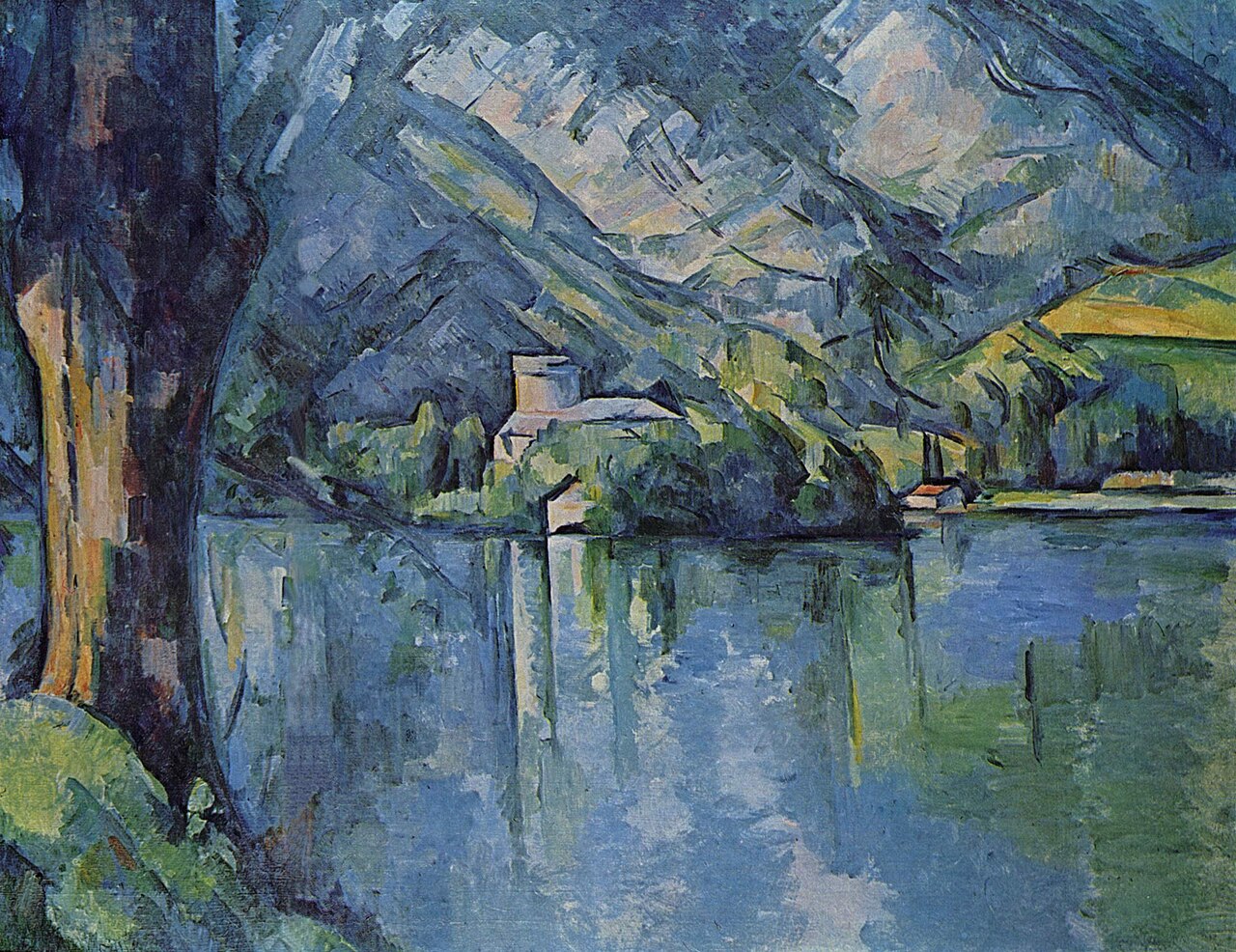
Research shows that the visual cortex does not passively receive light signals; it actively constructs images by filling in gaps and integrating context. This allows us to see unified objects even when faced with broken or abstract visual data. Cézanne’s brushwork — repetitive, exploratory strokes and contrasting planes of colour — takes advantage of this tendency by presenting suggestive fragments rather than fully defined forms.
- Perceptual inference — the observer mentally completes shapes, creating an interactive conversation between the painting and the brain.
- Neural activation — this interaction stimulates pathways responsible for recognising patterns, perceiving depth and distinguishing figure from ground.
- Active participation — the viewer becomes a participant in interpreting the image, constructing meaning through perceptual integration.
The Philosophical Connection with Nonduality
This scientific phenomenon has a philosophical counterpart in nonduality, where strict separations between subject and object, form and background, blur into a unified continuum. Cézanne’s style embodies the principle by intentionally disrupting clear boundaries.
The whole of nature seems concentrated on a single point.
Paul Cézanne
In landscapes such as Mont Sainte-Victoire, planes overlap without distinct edges, suggesting a reality that goes beyond binary oppositions like inside and outside, or figure and ground. The brain’s process of completion reflects nondual awareness — merging different elements into a seamless perceptual experience.
Late Paintings: Ambiguity as Engagement
Cézanne’s later works amplify these uncertainties. Paintings such as The Bathers and the late versions of Mont Sainte-Victoire reveal deliberate shifts between clarity and vagueness:
- Forms partially dissolve into surrounding colour fields.
- Spatial cues imply several viewpoints at once.
- Edges become blurred, inviting the viewer to navigate shifting interpretations.
These deliberate ambiguities engage higher cognitive functions concerned with resolving uncertainty and appreciating beauty. They challenge ways of seeing that depend on a fixed viewpoint, and promote an experiential understanding aligned with nondual thinking — the experience of wholeness without fragmentation. In this way neuroscience illuminates how Cézanne’s art reaches beyond representation, tapping into perceptual processes that resonate with ancient insight into the unity behind apparent diversity. The viewer’s mind becomes a partner in bringing forth the painting’s hidden wholeness, establishing a profound link between empirical perception and metaphysical truth.
Conclusion
Paul Cézanne stands as a crucial figure in the story of modern art, his work a deep combination of tradition and new ideas. His artistic journey shows a strong connection with nonduality — the ancient recognition that breaks down strict division and reveals unity within apparent diversity. That recognition shapes his use of form, colour and space, challenges the binary norms of nineteenth-century art, and opens paths towards new ways of seeing that the century after him would spend its energy exploring.