
Spirit CRM: Relationship-First Client Management
Most customer relationship tools are built around a funnel. They open on a revenue figure, push you toward the next sale, and quietly reduce the people you serve to a pipeline stage. Spirit CRM starts somewhere else. It opens on a page called Your Circle, it treats the people in front of you as relationships rather than leads, and it keeps money out of the headline. The result is a system that does the practical work of running a practice or a business without changing the tone of how you relate to the people who keep it alive.
This article walks through what Spirit CRM is, what it does, and how it serves individuals, businesses, and agencies across The Spiritual Agency membership.
Who it’s for
Built for anyone raising their vibration, not a niche
Spirit CRM was designed for anyone doing work that depends on ongoing human relationships. It is not narrowed to meditation teachers or a single profession. A coach, a therapist, a course creator, a small studio, a consultant, an agency owner: all of them are managing the same underlying thing, which is a circle of people and the commitments that flow between them.
The design choices follow from that. People are organised into Your Circle, and each person carries a gentle state rather than a sales label. Someone is New, Active, or Quiet. Nobody is a “cold lead” or a “lost account.” A renewal that is due is framed as a chance to reconnect, not as a debt to chase. The language is deliberate, because the language is what shapes how the tool makes you feel when you open it each morning.
Your Circle
Your Circle: the people layer
The heart of Spirit CRM is the people record. Each contact holds a name, email, phone, free-form notes, tags, and the New, Active, or Quiet state. You can search across your circle, filter by status and tags, and pull the whole list in or out by CSV, which matters when you are migrating from a spreadsheet or another system and do not want to retype a year of history.
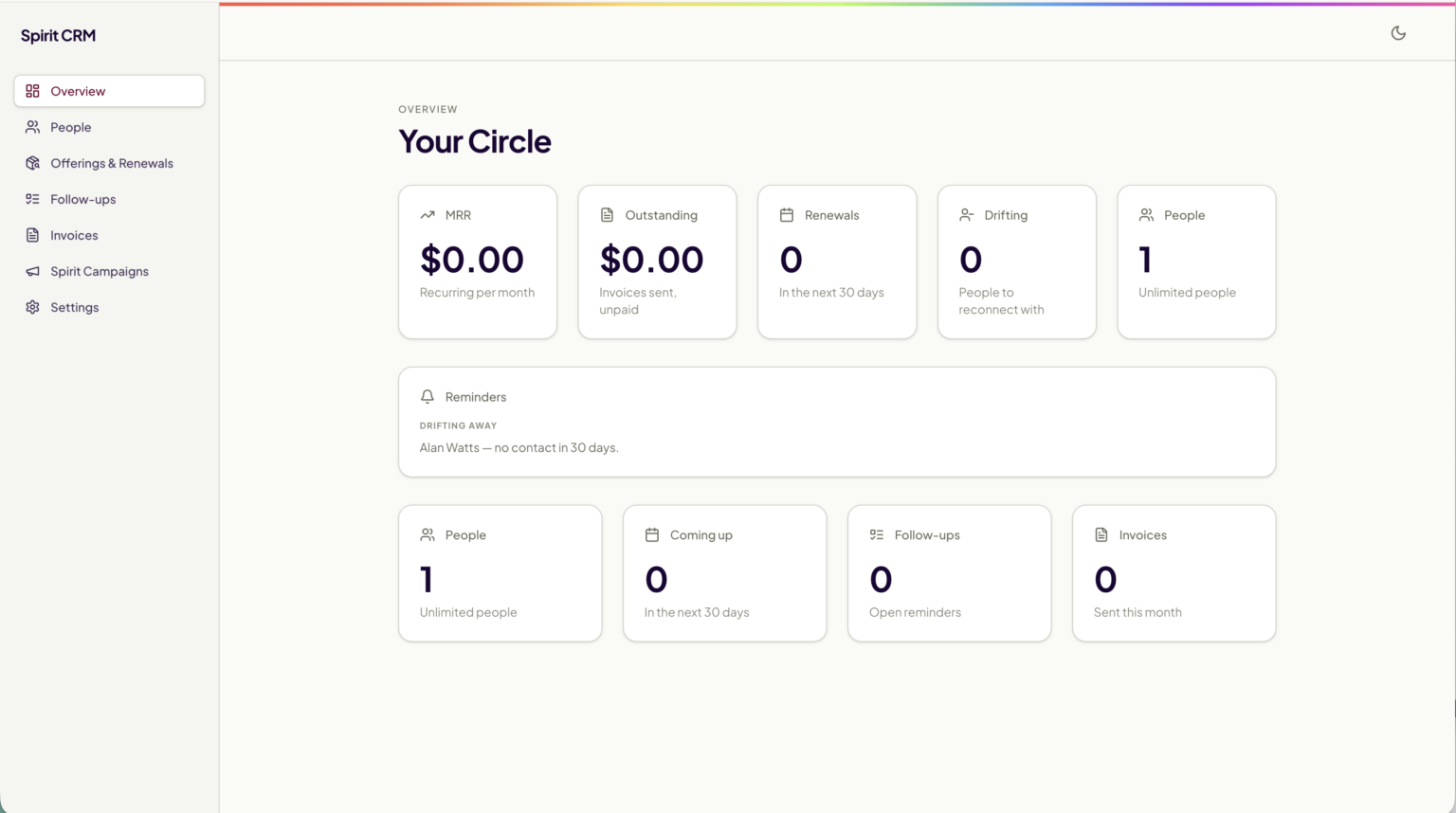
Every contact also carries an activity timeline. Calls, messages, sessions, and notable moments are recorded as interactions against the person, so the context of a relationship is in one place instead of scattered across an inbox. When you sit down to reach out to someone, you can see where you left off.
A quiet but useful piece of structure runs underneath this: people who go silent are flagged automatically. Spirit CRM watches for contacts who are drifting and surfaces them, rather than waiting for you to notice months later that you have not spoken. This is the reconnection principle made concrete. The tool nudges you toward the relationship before it lapses.
Offerings & invoices
Offerings, subscriptions, and invoices
Relationships in a working practice usually involve an exchange, so Spirit CRM carries the commercial layer without making it the centre of attention.
Offerings are the things you provide, whether a product or a service, priced as a one-off or as something recurring. Subscriptions connect a person to a recurring offering and track the next date it comes around, which is how renewals surface as reconnections rather than as dunning notices.
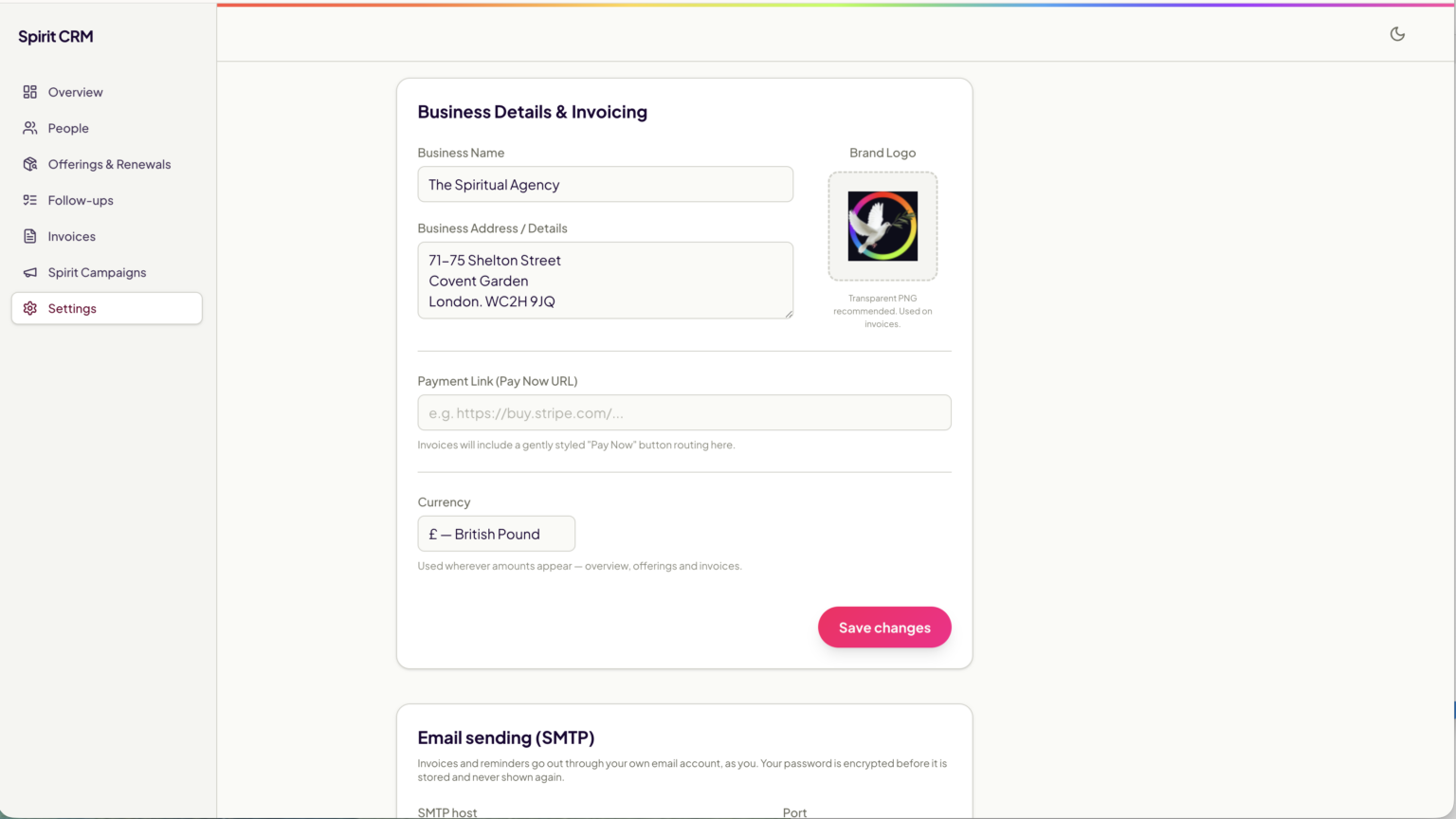
Invoicing is full and practical. You can raise an invoice against a person with line items, an amount, an issue date, and a due date, send it by email, and give the recipient a public page where they can view and pay it. Currency is flexible across pounds, dollars, and euros, switchable as your circle crosses borders. For members at the agency tiers, those public invoice and payment pages can be served on your own domain, so a client sees your brand end to end rather than a generic platform.
Follow-ups & automation
Follow-ups and gentle automation
Follow-ups live on a simple board with three columns: to do, doing, and done. It is intentionally light. The point is not to build a project-management cathedral, it is to make sure the small promises you make to people actually get kept.
Around that board sits a layer of gentle automation that does the remembering for you. Daily reminders keep the day’s reconnections in view. A digest email summarises what needs attention so the tool meets you in your inbox rather than demanding that you log in. And when you do sit down to write to someone, Spirit CRM can draft a check-in message for you with AI assistance, tuned to honour your instructions and to sound like a human reaching out, not a sequence firing. The drafts are a starting point you edit, never an autopilot, and they are capped so the feature stays a help rather than a firehose.
Spirit Campaigns
Spirit Campaigns: email and SMS, on your own terms
For members who need to reach their whole circle at once, Spirit Campaigns extends Spirit CRM into email and SMS marketing without leaving the system or its tone.
Campaigns are built around a shared audience picker, so you select recipients by status, by tag, or by hand, and the same selection drives an email send or an SMS send. The email composer supports rich content, merge fields so each message uses the person’s own name, a preview, and a test send before anything goes out. SMS works the same way through your own messaging account, with a segment counter so you can see the length of what you are sending.
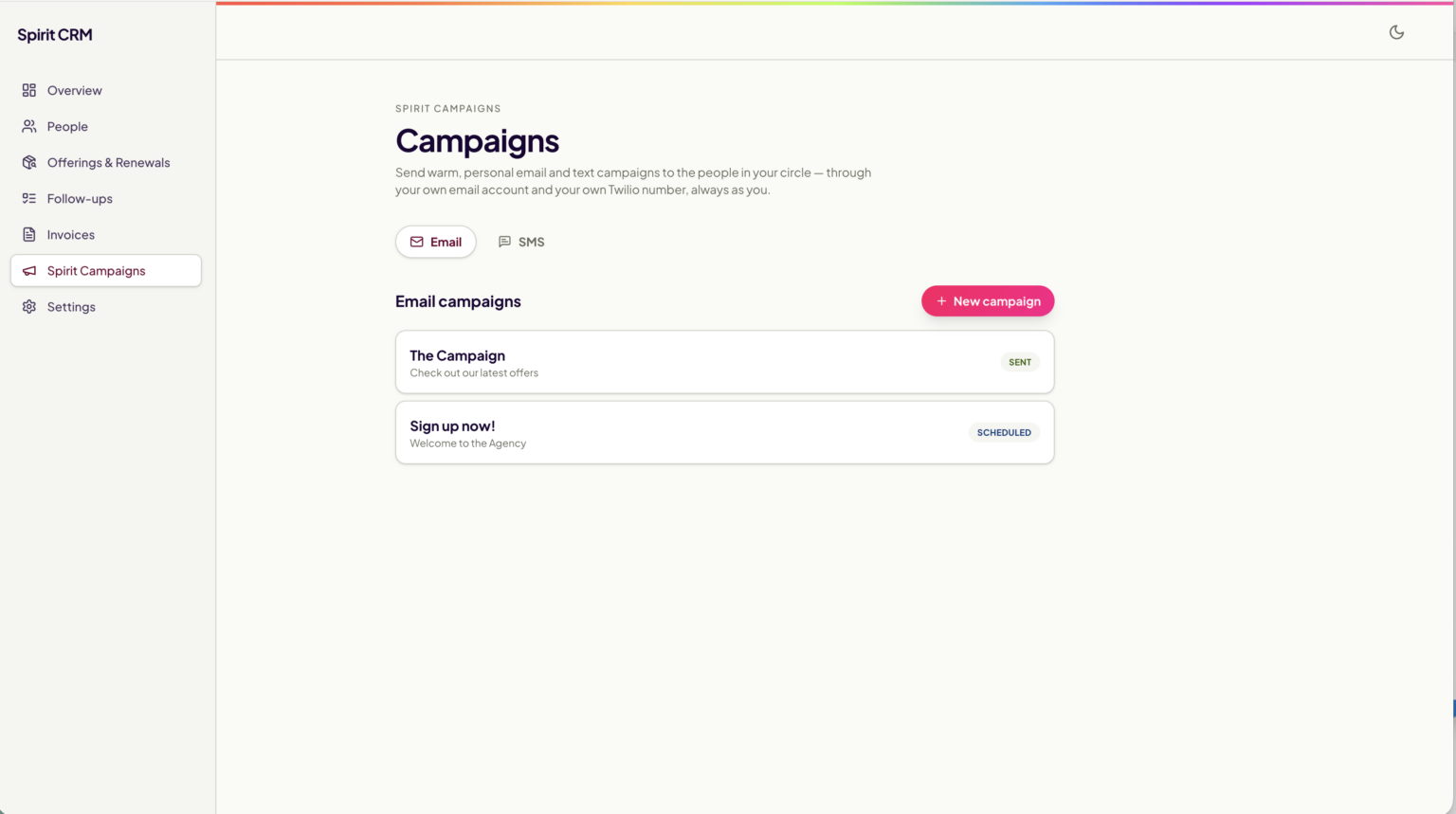
Two principles keep it grounded. First, you bring your own sending infrastructure: your own email server and your own messaging account, which means your deliverability and your costs stay yours, and the Agency is not a bottleneck between you and your people. Second, consent is respected by design. Every marketing email carries an unsubscribe link backed by a public opt-out page, per-person email and SMS opt-out flags are honoured on every send, and transactional messages like invoices and digests are never affected by marketing preferences. Campaigns can be sent now or scheduled for later, and once sent they report opens and clicks, including which individuals engaged, with an honest caveat that open tracking is noisy across the whole industry and clicks are the firmer signal.
Spirit Campaigns is available as an add-on at a flat 29.99 a month, or 299 a year, and is included as standard for members at the business tier and above. It runs alongside Spirit CRM rather than replacing any part of it.
How it scales
How it scales: one product, seven tiers
Spirit CRM is offered across all seven membership tiers of The Spiritual Agency, and the way it scales is structural rather than arbitrary. Because it is a native Agency product, it can start at the free tier, where the rest of the membership begins, and grow with the member from there.
The scaling is concrete and worth stating plainly. A free member can hold up to fifty people in their circle. The seed tier lifts that to five hundred. From the pro tier upward, the circle is unlimited. Core relationship features such as gentle statuses, offerings, and follow-ups open at the seed tier; invoicing and branding open at the pro tier; and white-label public pages on your own domain arrive at the agency tier, where members are running their own client-facing operations. The feature set reaches its full surface by the business tier and then holds steady, so higher tiers add scale and white-label reach rather than withholding basics.
This is the architecture The Spiritual Agency uses throughout its membership. Enterprise-grade products carry enterprise economics, and that surplus is what makes an accessible free and low-cost entry possible for everyone else. Spirit CRM sits squarely inside that design: a serious tool that a free member can start using today, structured so it keeps pace as their work grows.
Who it serves
Who it serves
For individuals and solo practitioners, Spirit CRM is a calm home for the relationships that are the practice itself. It remembers who is drifting, keeps the small follow-ups from slipping, and handles invoices without turning the work into a sales operation.
For businesses, it adds the commercial backbone: offerings and recurring subscriptions, full invoicing with payment pages, multi-currency, CSV import and export for clean migration, and email and SMS campaigns through Spirit Campaigns when it is time to speak to everyone at once.
For agencies, the higher tiers turn Spirit CRM into a client-facing surface. White-label public pages on your own domain mean a client sees your brand rather than ours, and the unlimited circle and full feature set support the scale of running an agency rather than a single practice.
One login
One login, no second tool
Spirit CRM is native to The Spiritual Agency platform. It is reached through the same membership login that opens the rest of the Agency, so there is no separate account to provision and no second password to keep. The work you do in Spirit CRM, the people, the invoices, the campaigns, lives inside the membership you already hold.
That is the quiet thesis of the product.
The practical machinery of running a relationship-led business should not require you to adopt the mindset of a sales funnel to use it. Spirit CRM does the administration so the relationship stays the point.