
A spiritual biography of Ramana Maharshi: his teenage awakening, his years at the sacred hill of Arunachala, and the direct path of self-enquiry held in one question, Who am I?
Ramana Maharshi, born Venkataraman Iyer in 1879, stands among the most significant spiritual figures of the twentieth century. He is remembered for his clear realisation and for his embodiment of jivanmukti, liberation while still living. His life joins an outward simplicity to a depth of wisdom that few have matched. Rooted in Advaita Vedanta and the recognition of nonduality, his teaching has crossed cultural and historical boundaries, and it continues to draw seekers across the world.
The Direct Path: A Unique Approach to Liberation
At the centre of Ramana Maharshi’s legacy is the Direct Path, a method marked by its directness and its clarity. Where other approaches are gradual or ritual-bound, this one asks the seeker to explore their true nature straight away, through self-enquiry. The practice is held in one question, “Who am I?”, and that question becomes a means of dismantling ignorance and waking to the true Self. The Direct Path sets aside elaborate philosophy and outward ceremony, and turns instead towards immediate, first-hand realisation.
Ramana Maharshi’s Impact on Advaita Vedanta
Ramana Maharshi holds a distinct place within Advaita Vedanta. His account of nonduality reaches past any single doctrine and offers a framework, both accessible and deep, for understanding consciousness beyond all dualistic division. He showed that the Self is not an abstract idea but an immediate reality, open to anyone willing to look within. With that, the work of spiritual seeking shifts from outward pursuit to inward discovery.
This article follows the spiritual biography of Ramana Maharshi, from a youthful awakening to a settled sagehood. It looks at his particular contribution to Advaita Vedanta and to nonduality, and at the place of self-enquiry as a practical means towards liberation. Through his life, his teaching and his lasting influence, the reader is invited into a body of wisdom that still shapes spiritual thought today.
Early Life and Spiritual Awakening
Venkataraman Iyer was born on 30 December 1879 in the village of Tiruchuzhi, Tamil Nadu, into a Brahmin family that held closely to traditional Hindu life. As a child he followed the rituals and the schooling expected of a boy destined for scholarly work. Yet where most boys his age were absorbed in worldly ambition and the company of friends, Venkataraman showed a quiet indifference to both. He turned inward instead, drawn towards a meaning that lay beyond achievement.
Disinterest in Conventional Studies
Through his school years he had little appetite for formal study and little interest in the approval of others. What he sought was an inner peace he could not yet name. That growing inclination was the first sign of the transformation soon to reshape his life.
The Life-Changing Experience
At sixteen, something decisive happened. He underwent what he later called a death-experience, an episode that would set the direction of the rest of his life. He felt a current, a force, take hold at the very moment his body seemed to fail. This was no mere physiological event. It was a direct recognition of the true Self, an unchanging essence present before birth and untouched by death.
“I felt myself being drawn into an intense light which possessed no form or shape… it was as though my body had been burnt to ashes… yet I remained aware.”
Ramana Maharshi
He later spoke of this as akarma mukti, a sudden liberation. It was a spontaneous release from identification with the ego and the body, arrived at with none of the gradual, preparatory practice that such freedom is usually thought to require. In a single stroke it made plain the difference between the perishable form and the deathless Self.
Shifting Identity
Once he recognised this current as his real identity, everything shifted. He no longer took himself to be a particular person with a particular history. He knew himself instead as that eternal essence, the reality named in the tradition as sat-chit-ananda, being, consciousness and bliss; as Iswara, the personal form of God; and known most simply as the Self. The clarity of that recognition outweighed every earlier attachment and ambition.
A Journey Towards Arunachala
Carried by this awakening, Venkataraman made a quiet and complete decision. He left his family and set out for Arunachala, the sacred hill held to be a form of Shiva and a beacon for those who seek the truth. On 1 September 1896 he reached Tiruvannamalai, the town at its foot, carrying nothing but trust in the silent pull of the mountain.
His leaving was not only a journey across distance. It was the surrender of every worldly identity in favour of a single, lasting reality. That solitary walk towards Arunachala began a lifelong devotion to inner exploration, and laid the ground for what would become one of the most influential paths within Advaita Vedanta.
Arunachala: The Sacred Abode of Ramana Maharshi
Arunachala, the mountain at Tiruvannamalai in Tamil Nadu, holds a high place in the spiritual geography of India. It is honoured as one of the country’s most potent centres of divine presence and pilgrimage. It is more than a landmark. In the tradition it is a living form of Shiva himself, an eternal flame held in stone and earth, and it has drawn seekers from across the world into its quiet field.
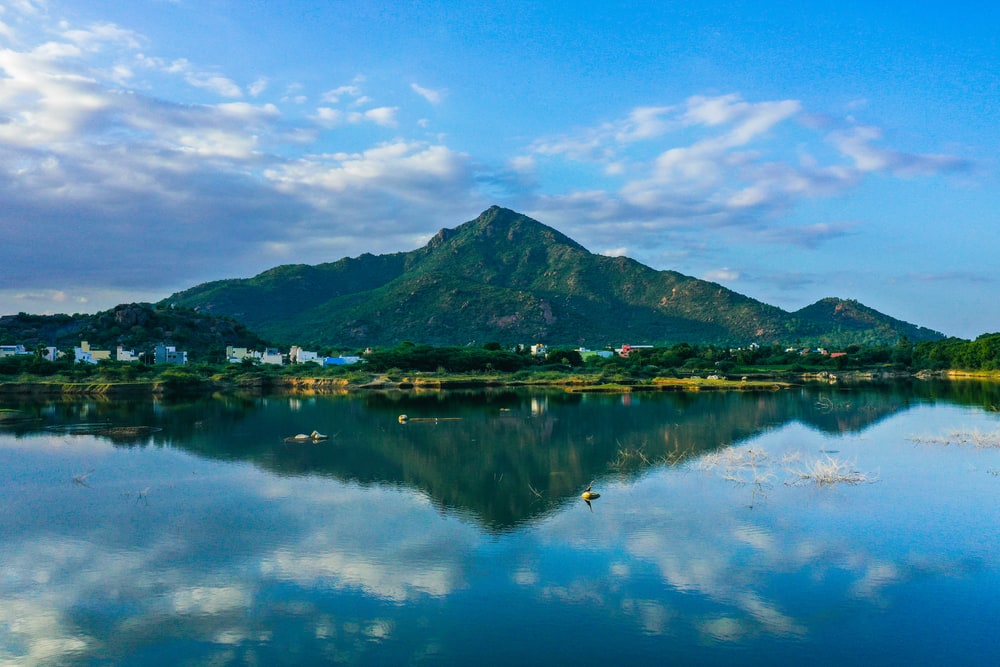
Spiritual Importance of Arunachala
The sanctity of Arunachala is rooted in both Hindu mythology and the philosophy of Advaita Vedanta. It is regarded as a lingam, a symbol of the formless absolute, Shiva. The mountain stands as a steady emblem of sat-chit-ananda, being, consciousness and bliss, the ultimate reality that lies beyond all form and name.
“Arunachala is the very heart of Shiva,” Ramana Maharshi said, pointing to the mountain’s identity with the Self. His own path was bound inseparably to this peak. He regarded it not only as his guru but as the final refuge of every aspirant.
Pilgrims walk the full circle of Arunachala in the practice known as girivalam, tracing its base, often by moonlight, as an act of purification and inward awakening. The practice rests on a long recognition that nearness to Arunachala loosens the boundaries of the ego and stirs a latent awareness to life.
Key Locations of Ramana Maharshi’s Life and Meditation
When he arrived at Tiruvannamalai in 1896, Ramana first settled within the precincts of the Arunachaleswara Temple, the ancient complex dedicated to Shiva, where he could sink into meditation in an atmosphere already charged with devotion.
In search of deeper seclusion, he moved into a small vault beneath the temple’s inner sanctum. There, undisturbed by the world outside, he sat in silent darshan for those who came with sincerity, while his attention rested without break on the Self.
He later moved to the precincts of the Gurumurtam temple on the slopes of the hill. The quieter setting allowed a closer communion with the surrounding land and a more intimate contact with the visitors his presence had begun to attract. Much of his teaching there was wordless, carried by gaze and by stillness.
Over the years Ramana lived at several other places on the hill. He spent some seventeen years in meditation at Virupaksha Cave, and used Skandashram Cave through the summer months as a retreat from heat and noise. Each place served at once as a hermitage and as a kind of working ground, where his realisation settled and from which it radiated outward.
The lasting draw of Arunachala lies in this union of landscape and awakened consciousness. The unmoving solidity of the mountain mirrors Ramana’s central counsel: that to abide as one’s true Self asks for an unbroken inner stillness, a steady turning away from passing things towards unchanging Being.
For the pilgrim, walking these places is a direct point of contact with the path Ramana taught, and a reminder that liberation is available here and now, under the steady gaze of the hill.
The Core Philosophy of Ramana Maharshi: Self-Enquiry (Atma Vichara) and Jnana Yoga
Ramana’s teaching is marked above all by its simplicity and its directness. At its centre stands the practice of self-enquiry, which he held to be the most effective means to self-realisation. It calls for no elaborate ritual and no philosophical debate. It asks only for a sincere turning of attention inward, towards the source of all consciousness and existence.
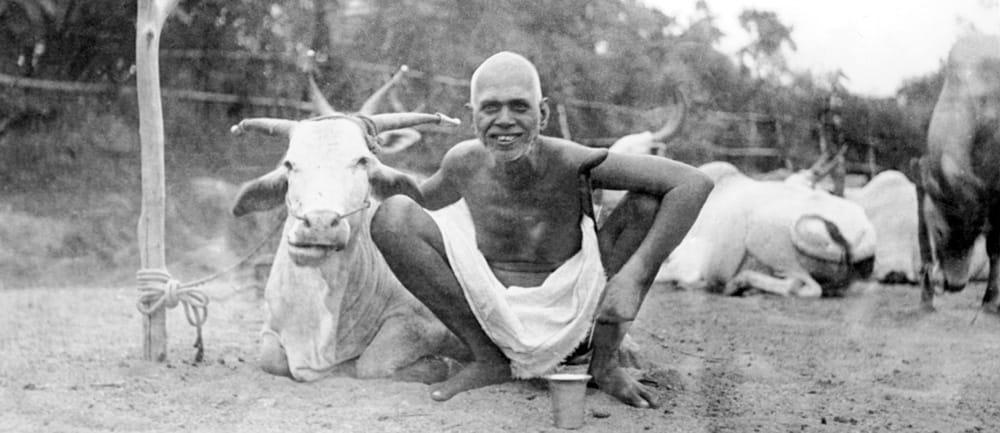
The Self-Enquiry Technique: A Path to Direct Realisation
Ramana asked seekers to hold steadily to a single question:
“Who am I?”
The question is not idle speculation, and not a puzzle for the intellect. It is an instrument. Held with care, it works like a mirror, showing up the false identities and passing states that obscure the true Self. By tracing the sense of ‘I’ back towards its origin again and again, the layers of ego and mental construction begin to dissolve, and the unchanging reality beneath them is laid bare.
The practice moves through a disciplined inward attention:
- Notice the sense of ‘I’ as it arises in experience.
- Question what it is. Is this ‘I’ the body, the mind, or something prior to both?
- Stay with the question until the personal ‘I’ subsides into its source.
Ramana was insistent that this enquiry is not an intellectual exercise but a living one. It draws the seeker fully into present awareness and uproots ignorance by exposing it directly.
‘Who am I?’ as an Instrument for Inward Investigation
The question serves two ends at once. It searches into our assumed identities, and it lights the way as it does so. It cuts through each layer of identity in turn, name, form, thought, and shows each one to be only an appearance. What is left, unmoved, is pure Being, untouched by change and by limit.
This wholehearted inward focus dissolves the division between the one who observes and the thing observed. The two meet, and what comes to light is not another object but one’s own essential nature. As Ramana put it:
“Your own Self-Realization is the greatest service you can render to the world.”
Such realisation shows that the ‘I’-thought is itself something passing, something that arises within consciousness rather than being consciousness itself. Through steady enquiry, this subtle misidentification with the ego is let go.
Relationship Between Self-Enquiry and Jnana Yoga
Self-enquiry sits closely with the classical path of Jnana Yoga, which holds knowledge, jnana, to be the way to liberation, moksha. Jnana Yoga turns on the discernment of the real from the unreal, the lasting from the passing.
Ramana’s contribution was to distil that ancient knowledge into a practice any sincere seeker could take up, without elaborate ritual or scholarly training. His teaching stays close to the core of Vedanta:
- Non-duality (Advaita): ultimate reality is non-dual awareness, and the distinctions we draw between self and other are not finally real.
- Sat-Chit-Ananda: the true Self is being (sat), consciousness (chit) and bliss (ananda).
- Maya: the world appears as separate and solid through ignorance, and realisation dissolves that appearance.
Within the framework of Jnana Yoga, self-enquiry is at once a philosophical investigation and a meditative practice. By returning steadily to the one question, the seeker cultivates direct knowledge rather than a set of concepts.
Ramana would point to the Upanishads and other classical texts to illuminate this truth, while making clear that study alone could never be enough. Realisation has to be lived:
“The enquiry into ‘Who am I?’ will destroy all thoughts except that thought which enquires into ‘Who am I?'”
That unrelenting inward attention leads at last beyond every mental construction into a settled self-awareness, which is the very aim of Jnana Yoga.
In this way Ramana renewed the central message of Advaita Vedanta for spiritual seekers of the modern age. His method of self-enquiry gathers centuries of metaphysical insight into a discipline that is both accessible and deeply transformative, and it continues to guide those who walk the direct path towards freedom.
The Global Influence of Ramana Maharshi: Bridging Eastern Wisdom and Western Spirituality
Rooted in Advaita Vedanta, Ramana’s teaching reached far beyond Arunachala to seekers across the world. His understanding and practice of self-enquiry renewed interest in nondual philosophy both in India and abroad, and became a steady point of reference for those seeking direct, first-hand knowledge of the Self.
Impact on Traditional Hindu Philosophy through Popularising Self-Enquiry
The practice of atma vichara, or self-enquiry, as Ramana taught it, marked a real shift within traditional Hindu thought. It placed immediate inward exploration ahead of ritual and scholarship. Its emphasis on a direct discovery of one’s own nature as pure consciousness stayed faithful to the heart of Advaita Vedanta, yet it also widened the door, making liberation a genuine possibility for anyone, regardless of caste, background or learning.
His insistence that the single question “Who am I?” could unwind the layers of ego and illusion gave fresh clarity and fresh urgency to the path of jnana yoga. His own realisation, that the ego is a passing phenomenon while the true Self remains as the unchanging witness, brought renewed life to classical texts such as the Ashtavakra Gita and the Mandukya Upanishad, and lent their study the weight of lived experience.
A number of modern Hindu thinkers and practitioners took up this direct path and carried Ramana’s approach into contemporary spiritual life. Because his teaching was both accessible and effective, serious enquiry was no longer the preserve of monastic life. It became a living practice for lay seekers as well.
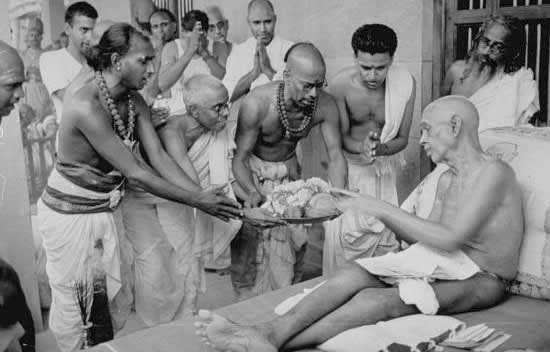
Key Western Disciples Who Documented His Life and Teachings
The meeting of East and West found fertile ground at Sri Ramanasramam, the ashram that grew up around Ramana. Many Western seekers came, drawn by accounts of his stillness and his evident wisdom, and several of them did much to carry his teaching to a wider audience through their writing, their talks and their translations.
- Paul Brunton: among the first Westerners to find Ramana, in 1931, Brunton introduced his philosophy to English-speaking readers in A Search in Secret India, conveying both the simplicity and the reach of self-enquiry.
- Arthur Osborne: a devoted disciple who settled near Arunachala, Osborne gathered many of Ramana’s dialogues into accessible books, among them Ramana Maharshi and the Path of Self-Knowledge, still a foundational text for students of the teaching.
- Maurice Frydman: an engineer who became a devotee, Frydman helped bring Indian spirituality into contact with Western intellectual life, supporting dialogues that clarified Ramana’s subtle teaching without diluting it.
- Ethel Merston and Mouni Sadhu: their detailed accounts joined biographical narrative to philosophical reflection, preserving the spoken teaching alongside their own contemplative insight.
These Western followers were not only disciples but interpreters. They placed Ramana within wider spiritual currents and showed how his teaching crossed cultural lines by speaking to questions every person faces: identity, suffering and freedom.
“The question ‘Who am I?’ urged upon us by Ramana Maharshi is not merely an intellectual exercise; it is an invitation into direct communion with eternal truth.”
This exchange between cultures did much to establish Ramana’s philosophy within modern global spirituality. By presenting Advaita Vedanta in the practical form of self-enquiry, he brought ancient Indian metaphysics into living contact with the spiritual searching of his own century.
The effect endures. For many communities today he remains a guiding figure, a steady point by which seekers orient themselves towards nonduality, and a sign of how clearly his work still joins East and West.
The Literary Legacy of Ramana Maharshi
Ramana’s teaching survives in a body of writing that includes recorded conversations, poems and brief sayings, and it continues to speak to seekers everywhere. These texts hold the essence of his philosophy, pointing again and again to the one enquiry, “Who am I?”, and they serve as a steady guide for those who follow the direct path towards self-realisation.
Insights into Self and Reality
His recorded words open clear insight into the nature of the Self and of reality. He did not rely on long treatises. He taught through brief, precise instruction meant to turn attention inward.
“Your own Self-Realization is the greatest service you can render the world.”
This places individual awakening first, as an act whose benefit reaches far beyond the person.
“The question ‘Who am I?’ will destroy all other questions and the questioner too.”
Here is the radical economy of self-enquiry. Held to its end, the turning of attention towards its own source dissolves every illusion, the questioner included.
“Happiness is your nature. It is not wrong to desire it. What is wrong is seeking it outside when it is inside.”
A reminder that true happiness is already the nature of consciousness, and does not depend on outward objects or experiences.
“Silence is also conversation.”
A pointer to Ramana’s own way of teaching, in which silence often carried more than speech, and presence itself became the means of transmission.
Compilations of Teachings
Several collections have gathered his spoken words and his verses, keeping the teaching available in clear form:
- Who Am I?, a foundational text drawn from conversations with devotees, which sets out the method of self-enquiry plainly and directly.
- Talks with Sri Ramana Maharshi, transcripts of the dialogues held during darshan, in which the philosophy is worked out in practical terms.
- Five Hymns to Arunachala, devotional poetry in praise of the hill, which stands at the same time as an image of the Self.
These works carry a double character. Devotional poetry runs alongside careful self-examination. The language stays simple, and holds a great deal of meaning within that simplicity.
The Power of Concise Statements
Ramana’s gift for carrying a wide truth in a few words shows a real mastery of language as an instrument of awakening. Each saying works like a seed set in the depths of consciousness, meant to open into insight when it is given attention.
- “The Heart is the seat of the ‘I’-thought.” This marks the place from which the ego arises, and to which enquiry must trace it back.
- “Let thoughts cease; then you will know that you are.” This points to the stillness in which the ever-present awareness, beneath all passing activity, becomes plain.
Sayings of this kind resist a quick reading. They ask for reflection, and for the test of experience, rather than mere intellectual agreement.
Cultural Impact
Ramana’s words have crossed cultural boundaries and entered contemporary spiritual conversation well beyond their original Hindu setting. They speak clearly to psychological work on self-awareness, and they have been taken up within modern studies of Advaita Vedanta across the world.
Devotees often describe how these brief instructions set lasting realisations in motion. The literary legacy is therefore not only a record of doctrine. It is a living guide that still moves seekers along the way towards nondual truth.
Carried and renewed through these texts, Ramana’s voice stays alive, a north star by which countless seekers find their way towards their own innermost reality.
Conclusion
The teaching of Ramana Maharshi, a master of the direct path, continues to guide those who seek self-realisation. His method of self-enquiry, held in the single question “Who am I?”, asks each person to look within, past intellectual understanding and past fixed ritual. In doing so they may come upon the unchanging reality, the true Self, that rests beneath the constant movement of thought, feeling and outward experience.
His teaching places direct experience before theory. The practice asks for no elaborate ceremony and no intermediary. It asks only for a personal investigation into one’s own existence. That simplicity is what keeps his guidance timeless, and open to people of every culture and faith, while it remains rooted in the ancient wisdom of Advaita Vedanta.
The method is best met with sincerity and patience, and with the understanding that liberation is not something gained from outside. It is an awakening to what has always been present. The direct path Ramana points to opens of its own accord when distraction is set down and attention is turned, steadily, towards the source of the ‘I’-thought.
“Your own Self-realization is the greatest service you can render the world.”
Ramana Maharshi
Met with honesty, humility and resolve, enquiry of this kind brings us into accord with Ramana’s role as a guide whose influence reaches well past his physical presence. His life shows how an unwavering devotion to truth can dissolve illusion and reveal a freedom that is both immediate and complete.
His invitation to self-enquiry is a practical way towards liberation, one that depends on no outward approval but only on the turning of attention inward, under the gentle and clear guidance of his teaching. The path stays open to every sincere seeker, a direct route home to the eternal essence of existence itself.